
The Average Diamond Carat Weight in 2026 and What It Really Means

When people talk about diamond size, what they usually mean is carat weight. It is the number everyone remembers, the spec that gets mentioned first, and the one most closely tied to price. But average diamond carat weight is not as straightforward as it sounds. It changes over time, it varies by country and it depends heavily on whether we are talking about natural or lab grown diamonds. What felt like a “normal” diamond twenty years ago would be considered small by many buyers today, even though nothing about that diamond itself changed.
In this guide, we are going to look at what the average diamond carat weight actually is today and why that average keeps creeping upward. If you want a deeper visual breakdown of how carat weight translates to real world size differences, you can explore a more detailed diamond education resource here. We will break down real buying data, explain what most people choose in practice rather than in theory, and clear up a few common misconceptions along the way. Spoiler alert, the average is not driven by millionaires buying huge rocks. It is driven by regular people trying to get the most visual impact for their budget while still feeling good about their choice.
What Is the Average Diamond Carat Weight Today
Today, the average diamond carat weight sits right around the one carat mark, but that number hides a lot of nuance. Carat is a unit of weight rather than size, and its use goes back centuries to early trade practices, which is why understanding its background matters. This is especially clear when GIA talks about the origins of the carat system, explaining how standardized weight measurements developed over time. In the United States, most natural diamond engagement rings land between 0.9 and 1.1 carats, with one carat acting as a psychological anchor more than a strict standard. People often say they want a one carat diamond, but what they really want is the look and presence they associate with that size.
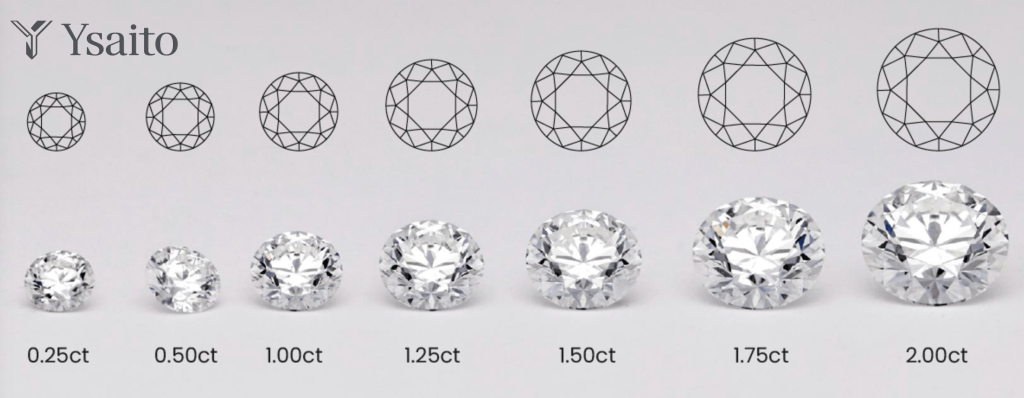
Lab grown diamonds have shifted the average upward. Because prices are lower, buyers are more comfortable choosing larger stones, which pushes the lab grown average closer to 1.5 to 1.75 carats. That does not mean tastes suddenly changed. It means budgets stretch further, and when given the option, many people choose a visibly larger diamond while keeping color and clarity high.
It is also worth noting that averages do not represent most individual choices perfectly. Many buyers intentionally stay just below popular thresholds like 1.00 carat to get better value, while others go slightly above for symbolic reasons. The average is best viewed as a reference point, not a rule. Diamonds are personal purchases, and real world buying behavior is far more flexible than a single number suggests.
Average Diamond Carat Weight in the United States
In the United States, the average diamond carat weight for engagement rings sits right around the one carat mark. Depending on the data source and year, you will usually see numbers between 1.0 and 1.1 carats for natural diamonds. That makes one carat not just a milestone size but also the statistical center of the market. It is the size many buyers aim for when they want something that feels substantial without pushing into extreme price territory.
Lab grown diamonds have shifted this average upward in recent years. Because they cost significantly less per carat, many U.S. buyers now choose lab grown stones in the 1.5 to 2.0 carat range while spending the same budget they would have allocated to a one carat natural diamond. As a result, when you look at combined data that includes lab grown diamonds, the overall average carat weight in the United States is noticeably higher than it was just a decade ago.
What is interesting is that this average does not necessarily reflect what people see on social media. Online photos and influencer posts often feature oversized diamonds that make larger stones seem normal or even expected. In reality, a one carat diamond is still the most common choice across the country and remains a very balanced option in terms of size, wearability, and value. Many buyers end up pleasantly surprised when they see how good a well cut one carat diamond looks in real life.
It is also worth noting that averages do not represent most individual choices perfectly. Many buyers intentionally stay just below popular thresholds like 1.00 carat to get better value, while others go slightly above for symbolic reasons. These cutoffs are not arbitrary either, as grading standards explain exactly how weight is reported, including GIA on how carat should be rounded.
Average Diamond Carat Weight Worldwide
When you look at diamond carat weight on a global scale, the first thing to understand is that there is no single worldwide average that fits every market. Diamond buying habits are heavily influenced by culture, income levels, and how engagement traditions are viewed in different parts of the world. In some countries, size is the main signal of commitment. In others, craftsmanship or symbolism matters far more than carat weight.
In North America and parts of Western Europe, average natural diamond engagement rings tend to fall around the one carat mark or slightly below. Buyers in these regions often balance size with cut quality and brand reputation. A well cut diamond just under one carat is commonly preferred over a larger stone with weaker sparkle. This mindset keeps the average relatively stable even as incomes rise.
Average Diamond Carat Weight by Region
| Region | Typical Average Carat Weight | Common Range | Popular Preferences | Typical Budget Focus |
|---|---|---|---|---|
| United States | 1.00 carat | 0.90 – 1.25 ct | Round cuts, strong emphasis on size visibility | Mid to high budgets with focus on perceived size |
| Canada | 0.90 carat | 0.80 – 1.10 ct | Round and oval diamonds, balanced quality choices | Value conscious with quality prioritization |
| Europe (Western) | 0.70 carat | 0.50 – 0.90 ct | Smaller stones, higher color and cut standards | Moderate budgets with focus on refinement |
| United Kingdom | 0.75 carat | 0.60 – 0.95 ct | Classic designs, subtle elegance | Balanced budgets, preference for timeless styles |
| Australia | 0.85 carat | 0.70 – 1.10 ct | Round and oval shapes, modern solitaires | Mid range budgets with size awareness |
| East Asia (Japan, South Korea) | 0.40 carat | 0.30 – 0.60 ct | Minimalist designs, very high cut precision | Lower budgets but high quality per carat |
| China | 0.50 carat | 0.40 – 0.80 ct | Growing preference for larger stones | Wide range from entry to premium buyers |
| Middle East | 1.20 carats | 1.00 – 2.00 ct | High color grades, luxury presentation | High budgets with emphasis on status |
| Latin America | 0.60 carat | 0.45 – 0.85 ct | Flashy appearance, warmer color tolerance | Value driven with visual impact focus |
| Worldwide Average | 0.70 carat | 0.50 – 1.00 ct | Balanced trade off between size and quality | Mixed budgets across global markets |
In parts of Asia, especially China and Japan, average diamond sizes are typically smaller. Engagement traditions there emphasize refinement and elegance rather than visual dominance. Diamonds in the 0.3 to 0.7 carat range are very common, especially when paired with minimalist ring designs. In these markets, a flawless looking diamond that sits neatly on the hand often matters more than reaching a round number in carats.
In contrast, markets like the Middle East and certain segments of India tend to favor larger diamonds when budgets allow. High net worth buyers in these regions often view carat weight as a visible status marker. Two carat and larger diamonds are more common here, particularly for special occasion jewelry rather than everyday engagement rings. This pushes the local average higher but only within specific buyer groups.
Globally, when you blend all regions together, the average natural diamond carat weight for engagement rings likely falls somewhere between 0.7 and 0.9 carats. That number hides a wide range of preferences, from compact elegant stones to bold statement pieces. What it really shows is that diamond size is a personal and cultural choice, not a universal rule, and the best carat weight is always the one that fits the buyer’s priorities rather than the global average.
Natural Diamonds vs Lab Grown Diamonds Average Carat Size
When comparing natural diamonds and lab grown diamonds, average carat size is one of the most noticeable differences. Natural diamonds tend to cluster around more conservative sizes because price rises sharply as carat weight increases. Buyers often aim for classic milestones like one carat or slightly under, balancing visual presence with long term value. As a result, the average natural diamond size worldwide remains relatively modest.
Lab grown diamonds tell a different story. Because they cost significantly less per carat, buyers are far more willing to go bigger. It is common to see lab grown engagement rings in the one and a half to two carat range, even among buyers who would never consider that size if purchasing a natural diamond. The lower price barrier shifts buyer psychology from cautious optimization to visual impact first.
This does not mean lab grown buyers care less about quality. In fact, many use the cost savings to increase both size and clarity or color. The difference is simply freedom. Natural diamonds encourage restraint and careful tradeoffs, while lab grown diamonds invite experimentation. In practice, this is why average lab grown diamond sizes continue to rise, while natural diamond averages remain steady and grounded in traditional buying behavior.
How Diamond Shape Affects Average Carat Weight
Diamond shape plays a bigger role in average carat weight than most people expect. Two diamonds can weigh exactly the same but look very different depending on their shape. This visual difference strongly influences buying behavior, which in turn affects what carat weights become most common for each shape over time.
Round diamonds tend to have slightly lower average carat weights compared to fancy shapes. The reason is simple. Rounds are cut to maximize light performance rather than spread. More of the weight is concentrated deeper in the stone, which means buyers often need to go up in carat weight to achieve the same visual size they might get from another shape. As a result, many buyers stop at classic milestones like one carat or one and a half carats.
Also if you compare two round-cut diamonds visually to each other, sometimes it’s even difficult to distinguish a 0.75ct and 1.0ct diamond, as we show in our article on diamond carat weight vs diamond size. That is mostly an issue of diamond cut quality an it surprises quite a lot of people.
Elongated shapes like oval, marquise, pear, and emerald cut usually show higher average carat weights. These shapes face up larger for their weight, giving buyers more visible size without paying for extra carat weight they cannot see. Someone who wants a bold look without crossing a major budget threshold often ends up choosing one of these shapes, which gradually pushes their average carat sizes upward.
Square shapes such as princess and cushion cuts sit somewhere in the middle. Princess cuts often cluster around popular round diamond weights, while cushions tend to creep slightly larger. Cushions have a softer outline and often look smaller than their weight suggests, so buyers frequently compensate by choosing a higher carat size to achieve the presence they want.
Over time, these visual preferences shape the market. Rounds dominate overall sales but stay conservative in carat weight. Elongated fancy shapes attract buyers looking for size efficiency and therefore trend larger. It is not that people suddenly want heavier diamonds, they simply want the diamond to look bigger on the hand. Shape quietly makes that decision for them.
Why the Average Diamond Carat Weight Keeps Increasing
One of the biggest reasons average diamond carat weight keeps going up is simple confidence. Buyers today are far more educated than they were even ten years ago. They understand that a well cut diamond can look larger than its carat weight suggests and that smart compromises on color or clarity often go unnoticed to the naked eye. Once people realize they do not need perfection on paper, they feel comfortable going bigger.
Lab grown diamonds play a huge role here as well. When price pressure is removed, psychology changes. A buyer who might have capped themselves at one carat with a natural diamond suddenly sees that one and a half or even two carats are realistic options. Even buyers who ultimately choose natural diamonds are influenced by this shift because it resets expectations around what is considered a normal size.
Social visibility is another major factor. Engagement rings are shared online constantly, whether on Instagram, TikTok, or WhatsApp family groups. Bigger stones simply stand out more in photos and videos. That visibility creates a subtle pressure loop where what used to feel large now feels average, and average starts to feel small. No one is consciously competing, but the reference point quietly moves upward.
Ring design has also evolved to support larger center stones. Thin bands, minimalist settings, hidden halos, and open galleries all make it easier to wear a bigger diamond without the ring looking bulky or impractical. A one and a half carat diamond today often looks elegant rather than flashy, which was not always the case in older, heavier settings.
Finally, there is a mindset shift toward value rather than tradition. Many buyers are less attached to rigid rules like one carat milestones and more focused on visual impact for their budget. If a slightly larger diamond delivers more presence for the same money, most people will take it. And once enough people make that choice, the average naturally rises.
How to Choose the Right Carat Weight for You
Choosing the right carat weight is less about chasing a number and more about understanding what actually fits your life, your style, and your budget. The biggest mistake people make is starting with a target carat weight instead of starting with how they want the diamond to look on the hand. Two diamonds with the same carat weight can look very different depending on cut quality, shape, and finger size.
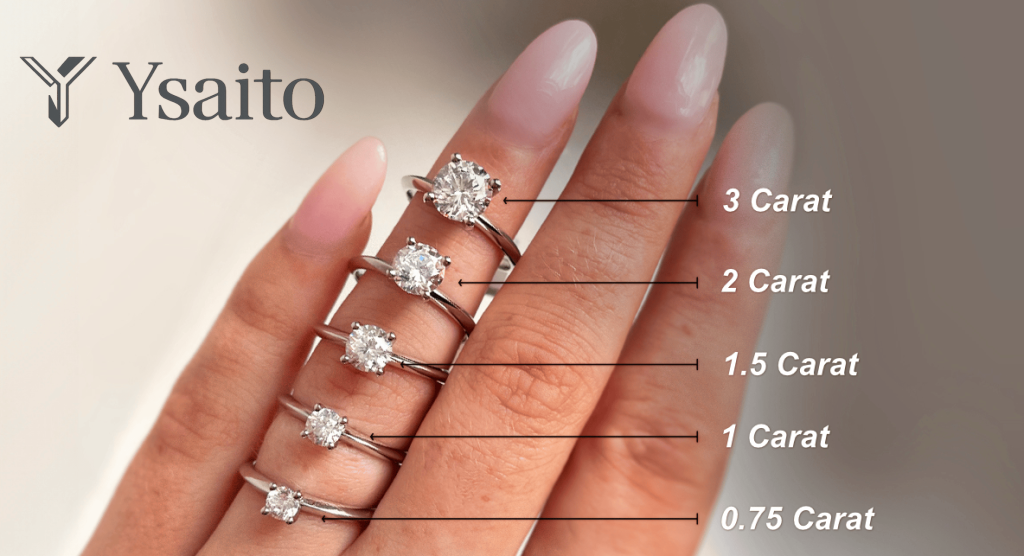
Budget always plays a bigger role than people initially admit, and that is perfectly fine. A well cut diamond just under a popular weight like 1.00 carat or 2.00 carats can look almost identical in size while costing noticeably less. Those small differences often free up room to improve cut quality or color, which usually has a bigger visual impact than a few extra points of carat weight.
Lifestyle matters too. If the ring will be worn every day, comfort and practicality should not be ignored. Larger diamonds can look stunning, but they can also catch on clothing or feel top heavy depending on the setting. For some people that is part of the appeal. For others it becomes annoying over time. There is no correct answer here, only what feels right on your hand.
It also helps to think long term. Trends change, but proportion and balance age well. A diamond that looks harmonious today will still look good decades from now. Many buyers find that choosing a carat weight that feels intentional rather than maximal leads to fewer regrets later on.
In the end, the right carat weight is the one that makes you happy every time you look at it, without causing stress about cost or practicality. If you find yourself smiling when you see it on your hand and not worrying about what you could have done differently, you probably chose well.