
When people say a diamond looks big or small, they almost always jump straight to carat weight. It feels logical. Bigger number equals bigger diamond, end of story. Except that is not how diamonds actually work. Two diamonds with the same carat weight can look noticeably different on the hand, sometimes enough to make buyers wonder if they are looking at the wrong stone.
The confusion comes from mixing up weight with visual size. Carat weight measures how heavy a diamond is, not how wide it looks from the top. A lot of that weight can be hidden in depth, tucked away where no one ever sees it. Meanwhile, another diamond with the same carat weight can spread that weight out more efficiently and appear larger even though the scale would say they are equal.
This is why carat weight and diamond size are related but not interchangeable. Understanding the difference can save you money, prevent disappointment and help you choose a diamond that actually looks the way you expect it to. Think of it like buying shoes. Two pairs can be the same size on paper, but one fits and looks better the moment you put it on. Diamonds are not that different.
What Carat Weight Actually Measures
Carat weight is a measure of how much a diamond weighs, not how big it looks. One carat equals exactly 0.2 grams, which is a standardized metric measurement used worldwide. As explained in GIA’s carat weight article, carats are further divided into 100 points, allowing diamonds to be measured and rounded with very high precision. This scientific consistency is why the jewelry industry relies on carat weight as a baseline. But while the number is precise, it still does not tell you how large the diamond will appear once you look at it face up on the hand.
What carat weight really measures is the total mass of the diamond, including the parts you cannot see once it is set in a ring. A diamond carries weight in its depth, especially in the pavilion, which is the lower portion beneath the girdle. Two diamonds with the same carat weight can distribute that weight very differently, and that difference changes how large or small they appear on the hand. If you want a broader grounding in how carat fits into the bigger picture of diamond evaluation, we cover the fundamentals in more detail in our diamond carat weight basics.
This is where many buyers get tripped up. People often assume that higher carat automatically means bigger looking, but that is not always true. A poorly proportioned diamond can hide a surprising amount of weight where no one ever sees it. Meanwhile, a well cut diamond with the same carat weight can look noticeably larger simply because more of that weight is spread across the top. Carat weight is real and important, but it is only one piece of the size puzzle.
Why Two Diamonds With the Same Carat Can Look Different
At first glance, it feels logical to assume that two diamonds with the same carat weight should look the same size. After all, the number is identical, so the diamond should be identical too, right? In reality, carat weight only tells you how heavy the diamond is, not how wide it looks when viewed from the top. This is one of the most common surprises buyers experience when they start comparing diamonds side by side.
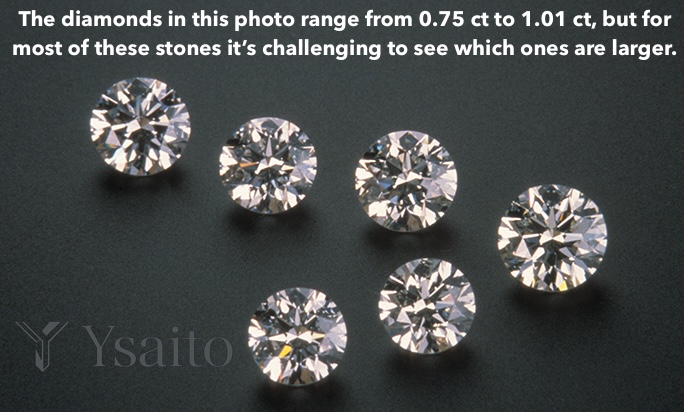
The biggest reason for this difference is cut proportions. A diamond can carry more of its weight deep in the pavilion, making it heavier without appearing larger. Another diamond with the same carat weight might spread more of that weight across the top, giving it a wider face up appearance. To the eye, the second diamond often looks noticeably bigger even though both weigh exactly the same.
Depth percentage plays a major role here. A deep cut diamond hides weight below the girdle, which adds carats without adding visible size. A shallower but well balanced diamond uses its weight more efficiently, creating more surface area. This is why experienced buyers often focus on millimeter measurements rather than carat weight alone.
Diamond shape adds another layer to this effect. Elongated shapes like oval, pear, marquise and emerald cuts naturally face up larger than round diamonds of the same carat weight. That does not mean they weigh less. It simply means their geometry spreads the weight differently. This is why someone switching from a round to an oval often feels like they gained size without paying for extra carat weight.
Finally, cutting decisions are influenced by the rough diamond itself. Sometimes cutters prioritize saving weight over achieving ideal proportions, especially when staying above a popular carat threshold like one carat. That choice can result in a heavier diamond that looks smaller than expected. This is why two diamonds with the same carat weight can look surprisingly different on the hand, and why carat alone is never the full story when it comes to visual size.
Cut Quality and Its Effect on Visible Size
Cut quality is the quiet hero behind how big a diamond actually looks. Two diamonds can weigh exactly the same, but the one with better cut proportions will almost always appear larger and brighter. That is because cut controls how light moves through the stone and how much of that light returns to your eye. When light performance is strong, the diamond looks lively and expansive. When it is weak, the diamond can look sleepy and smaller than expected.
A well cut diamond uses its carat weight efficiently. The table size, crown angle, pavilion depth, and overall symmetry work together to spread the diamond visually across the finger. Poorly cut diamonds often hide weight in the bottom where you cannot see it. That extra depth adds carat weight on paper but does nothing for face up size. It is like buying shoes with very thick soles when all you wanted was a wider fit.
Shallow or deep cuts both come with tradeoffs. A diamond that is too shallow may look wide at first glance, but it often leaks light and lacks sparkle, which makes it feel flat and glassy. A diamond that is too deep may sparkle in spots but looks smaller overall because much of the weight is buried below the girdle. The best cuts strike a balance where brightness, fire, and spread all work together. That balance is what makes a diamond look bigger without actually being heavier.
This is why experienced buyers often prioritize cut over raw carat weight. A slightly smaller diamond with an excellent cut can easily outshine a heavier diamond with average proportions. In real life, people notice sparkle and presence long before they notice a few extra points of weight. If you want a diamond that looks impressive without paying for invisible mass, cut quality is where the real size advantage comes from.
Diamond Shape and Face Up Size
Diamond shape has a surprisingly strong influence on how large a diamond appears once it is set in a ring. This visible footprint is often called face up size, and it refers to how much surface area the diamond covers when viewed from above. Two diamonds with the same carat weight can look noticeably different simply because one spreads its weight across the top more efficiently than the other.
Round diamonds are the reference point most people subconsciously use when judging size. They are cut for optimal light performance, not maximum spread. That means more of the diamond’s weight is carried in depth rather than width. A one carat round diamond looks beautiful and balanced, but it will usually appear smaller than a one carat diamond in many elongated shapes.
Elongated shapes like oval, marquise, pear, and emerald cut tend to have larger face up dimensions for the same carat weight. These shapes stretch weight lengthwise, creating a bigger visual presence on the finger. This is why buyers who want their diamond to look as large as possible without increasing carat weight often gravitate toward these shapes. It is not magic. It is geometry.
Square and rectangular shapes like princess and cushion cuts fall somewhere in between. Princess cuts often face up slightly smaller than rounds at the same carat weight due to their depth. Cushions vary widely depending on how they are cut. Some cushions are deep and chunky, while others are stretched and airy. Two cushions with identical carat weights can look very different side by side.
Understanding face up size helps explain why carat weight alone is not a perfect measure of visual impact. Shape determines how efficiently that weight is used where your eye actually looks. If your goal is presence rather than a specific number on a grading report, choosing the right shape can often matter more than adding extra carat weight.
Why Buyers Often Overestimate Carat Importance
Many buyers overestimate the importance of carat weight because it is the easiest number to understand. Bigger number feels like better diamond. It is simple, measurable, and easy to brag about. Cut quality, proportions, and light performance are harder to visualize and even harder to explain at a dinner table. So carat weight ends up carrying far more psychological weight than it deserves. Even GIA emphasizes that carat weight alone is a poor shortcut for judging a diamond and their breakdown of the topic offers a clear overview, including why size, cut and value do not always move together, as explained by GIA talking about 9 things to know about carat.
Another reason carat gets overvalued is marketing. Jewelry ads, sales conversations, and even search filters tend to lead with size. When someone hears “one carat diamond” it sounds like a complete description, even though it tells you almost nothing about how the diamond will actually look. Two diamonds with the same carat weight can feel worlds apart in brightness, balance, and presence once they are on the hand.
There is also a natural fear of regret. Buyers worry that if they choose a smaller carat weight, they might later wish they had gone bigger. Ironically, the opposite happens just as often. People who prioritize carat over cut sometimes end up with a diamond that looks dull or smaller than expected, even though the number on the certificate is higher. That disappointment usually sticks around longer than the thrill of hitting a round number.
In reality, the diamonds that make people happiest are rarely chosen by carat weight alone. They are chosen because they look right. They sparkle the way the buyer imagined. They sit comfortably on the hand and feel balanced with the setting. Once those boxes are checked, the exact carat number becomes far less important. Carat weight matters, but it matters most when it works together with cut, shape, and proportions rather than trying to steal the spotlight on its own.